

A small business owner in Accra sends us a message like this almost every week:
“I want to get my business online. What do I actually need — a website, WhatsApp, an app, a system for my orders? I am not sure.”
The honest answer is usually not “everything at once.” It is this:
Start with the step that solves the most urgent problem, and add the next one when it is clearly worth it.
Many businesses over-buy. They invest in a large system before the basics are in place, or they skip a step and lose customers because the underlying process is broken.
This article gives you a simple, three-step path. You will be able to see which step you are on, and which one to take next — without buying anything you do not need yet.
1. The three steps at a glance
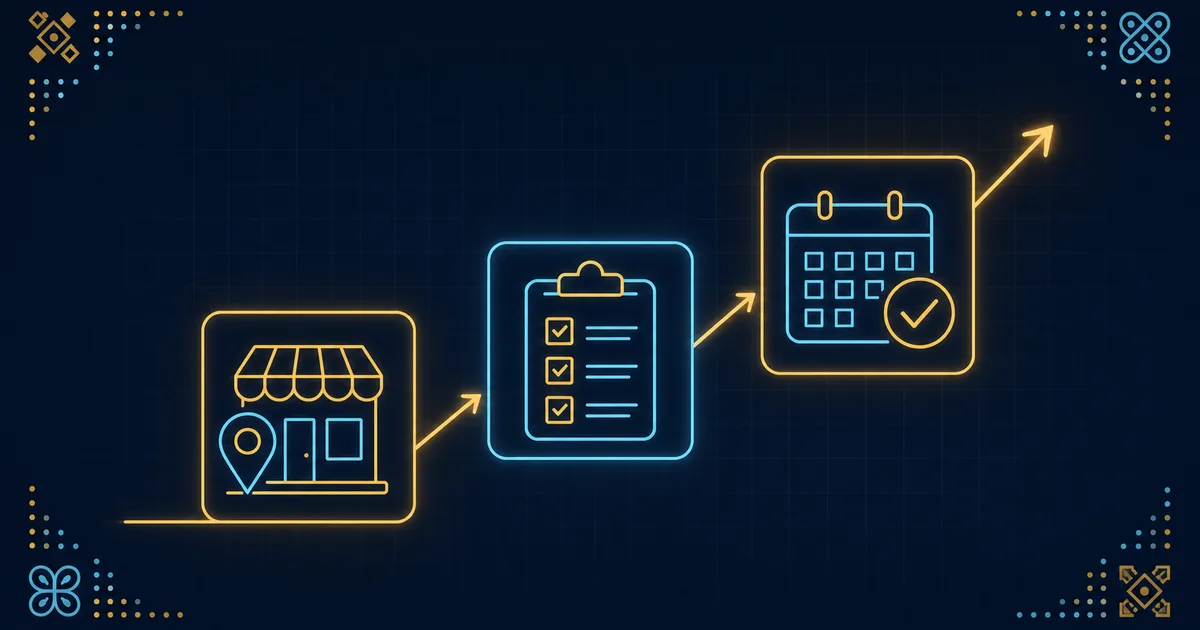
Think of your digital setup as a ladder. Each step builds on the one before it. You can stop at any level, and you can always add the next step later.
Step 1 · Get found & respond
    ↓
Step 2 · Track every enquiry
    ↓
Step 3 · Book & get paid
Step 1: Get found and respond
This is the entry point. The goal is simple:
- customers can find your business,
- and when they contact you, you respond professionally and on time.
This is where you set up your Google Business Profile, WhatsApp Business, a branded business email, and clean invoice and quotation templates. It makes your business look organised and trustworthy from the first impression.
Step 2: Track every enquiry
Once customers are reaching you, the next problem appears: you start losing them.
A customer sends a message, you say “I will get back to you,” and then the enquiry disappears in the chat. You forget to follow up. A lead goes cold because you never tracked it.
This step adds an enquiry form, a lead and quotation tracker, status tracking with a simple dashboard, and follow-up templates. Now no enquiry slips through, and you can see exactly who owes you a response.
Step 3: Book and get paid
The final step is for businesses that take appointments, bookings or custom orders. Here, staying organised by memory is no longer enough.
This step adds booking or order intake, automatic confirmations and reminders, deposit tracking, and 24-hour reminders. It handles scheduling and payments so nothing is double-booked and no deposit is forgotten.
2. Where you start depends on your biggest problem
The right first step is not the cheapest one — it is the one that solves the problem hurting you most today.
Start at Step 1 if you are hard to find or slow to respond
Your problem looks like this:
- customers do not know you exist,
- you have no presence on Google,
- you reply to enquiries hours later,
- your business email looks like a personal Gmail address,
- or customers cannot easily see what you sell or how to reach you.
Start with the SME Digital Starter Kit.
Start at Step 2 if customers reach you but enquiries slip away
Your problem looks like this:
- you get enquiries on WhatsApp, phone and social media,
- but you forget to follow up,
- you do not have a clear list of who wants what,
- you have no idea how many leads you turned into sales,
- or records are scattered across chats, notes and memory.
Start with Business Systems Setup.
Start at Step 3 if you take bookings, appointments or custom orders
Your problem looks like this:
- you book clients by phone or chat and sometimes double-book,
- customers forget their appointments,
- deposits are not tracked so work starts without payment,
- or you take custom orders and struggle to keep track of specifications and delivery dates.
Start with the Booking or Order Workflow.
3. Why you should not skip a step
Skipping ahead usually costs more, not less.
For example, a business might go straight to a booking system (Step 3) while still:
- having no presence on Google Maps (missing Step 1),
- replying to enquiries late (missing Step 1),
- and losing leads because there is no tracker (missing Step 2).
In that case, the booking system is built on a shaky foundation. Customers who do find the business still get slow responses, and leads still disappear.
The same is true in reverse. If a business invests heavily in being found (Step 1) but has no way to capture or follow up enquiries (Step 2), it turns visibility into wasted effort — finding customers it then loses.
The ladder works because each step makes the next one more valuable.
4. A simple way to decide
Answer these four questions honestly:
- Can customers find me? — Am I on Google Maps? Can people easily see what I do and where I am?
- Do I respond quickly and professionally? — Do I reply on time, with clear information, using a proper business setup?
- Do I keep track of every enquiry? — Do I know who contacted me, what they wanted, and whether I followed up?
- Do I handle bookings and payments reliably? — Do I avoid double-bookings, confirm appointments, and track deposits?
Wherever you answered “no,” that is your next step.
| If your answer to… | Is “no” | Your next step |
|---|---|---|
| Can customers find me? | 👉 | Step 1 — SME Digital Starter Kit |
| Do I respond quickly and professionally? | 👉 | Step 1 — SME Digital Starter Kit |
| Do I keep track of every enquiry? | 👉 | Step 2 — Business Systems Setup |
| Do I handle bookings and payments reliably? | 👉 | Step 3 — Booking or Order Workflow |
5. What each step includes
Here is exactly what you get at each level, so you know what you are paying for.
Step 1 — SME Digital Starter Kit
- Google Business Profile setup,
- WhatsApp Business setup,
- branded business email,
- invoice and quotation templates,
- owner training.
Scope: This gets you visible and responsive. It does not yet include records or scheduling.
Step 2 — Business Systems Setup
- everything in the Starter Kit,
- enquiry form,
- lead and quotation tracker,
- lead status and a simple dashboard,
- follow-up templates.
Scope: This adds the sales pipeline — capture, track and follow up. It is not scheduling.
Step 3 — Booking or Order Workflow
- everything in Business Systems Setup,
- booking or order intake,
- confirmations and reminders,
- deposit tracking,
- 24-hour reminders.
Scope: This adds scheduling and deposits, for appointment-based and custom-order businesses.
6. Do you need everything at once?
Almost never.
Most small businesses do not need every module on day one. The ladder is built so you can:
- start where you are,
- see real value from each step,
- and add the next step when it is clearly worth the cost.
This also means you are not overpaying. If you already have a Google Business Profile and a website, you should only pay for the steps you are missing — not re-buy what you already have.
That is why the right first question is not “what is the biggest package?” but “what is the most urgent problem right now?”
7. A note on how pricing works
Each step has its own starting price, based on its defined scope. This keeps the offer honest: you know what you are getting and roughly what it will cost before you begin.
The final cost depends on what you already have in place. A business that already has a website or a Google profile is quoted only for the additions it needs. Third-party costs — such as Google Workspace, SMS, CRM subscriptions, payment-gateway fees and booking platforms — are separate and agreed in writing.
If a website is part of the plan, read how much a website costs in Ghana in 2026 before you budget — it covers both the launch fee and the annual running costs that follow.
E Light Services is an independent technology consultancy. It is not affiliated with Google, Meta or WhatsApp, and does not control the policies, limits or feature changes of those platforms.
Which step is right for you?
You do not need to buy the whole system before you can see the value. Start with the step that solves the problem costing you the most, then grow when the value is clear.
E Light Services helps Ghanaian small businesses choose and set up the right digital step — without unnecessary complexity or overpaying for modules you do not need.
- Request the SME Digital Starter Kit
- Request business systems setup
- Request booking or order workflow
- View our Digital Systems starting prices and scope
If you are not sure which step fits, tell us what your business does and what is slowing you down. We will recommend the most practical first step.